Brad's Ultimate New York Yankees Website - www.HistoryOfTheYankees.com
Welcome to the page for:
Macombs Dam Park

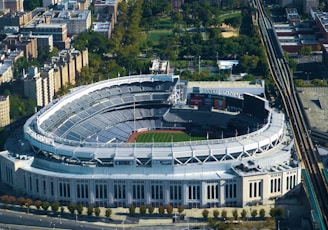
Macombs Dam park that was built by the New York City Parks Department on the site of Old Yankee Stadium.

The size of the entire park is 17 acres. 7 acres is the upper track and field area. The lower area of ball fields is 10 acres.
The park is located between 157 Street, West 161 Street, and East 164 Street in the South Bronx, New York.
NYC first acquired the land for the original park in 2 parcels in 1897 and then in 1924. The park opened in 1899.
The original designer of the old park was architect and lead designer Clarke Caton-Hintz. Thomas Balsley Associates was the conceptual designer and Wendy Evans Joseph was the consultant architect. The engineering consultant for the old park was Stantec. The old park was constructed by Hunter Roberts Construction and Prismatic Development Corp. The program manager for the original park was AECOM(formerly DMJM Harris), and Tishman Construction.
The new 7 acre track and field area honor legendary Bronx coach Joseph James Yancey Jr. Born in 1910, Yancey co-founded the New York Pioneers Track and Field Club in 1936. He grew up in Harlem and was a star athlete at Saratoga High School and later Virginia State College and NYU. He was the head coach of the Jamaican Olympic Track and Field Team in 1948, 1952, and 1956. He has been inducted into the Black Athletes Hall of Fame, the National Track and Field Hall of Fame, and the Harlem Professionals Inc. Hall of Fame. He passed away on February 22, 1991 in Teaneck, New Jersey and is buried in Hawthorne, New York.

The new track and field and surrounding park was built at a cost of $35 million as part of a total $195 million investment to build new parks and recreational facilities through the Yankee Stadium Redevelopment Program.
The new track and field features a 400 meter track with an all-weather Mondo surface. The park also features a field for soccer and football, basketball courts, handball courts, public toilets, adult fitness equipment, youth play equipment, as well as landscaped viewing mounds and a 600-seat grandstand for spectators.
The company in charge of designing the new park was "Doyle Partners".
The park consists of 3 ball fields. One is a championship field, one a little league field, and one a softball field. Along with the fields in the 10 acre area are a discus area, a shot put area, and a javelin area.
There is blue synthetic grass which outlines the original Yankee Stadium field, circa 1976.(Credit: Mike Hagan)

The viewfinders were designed by Steve Cozzolino.
There are 49 pavers, three benches, and one historic wall to honor the Old Yankee Stadium.
It was Dr. Harvey Frommer who was hired to draft the most historic events to be inscribed onto the pavers. Each paver is filled with epoxy.
The quote on the outfield fence, "SOMETIMES YOU WIN, SOMETIMES YOU LOSE, SOMETIMES IT RAINS.", is from the movie "Bull Durham". The idea to use the quote was that of Emil Martone, a client from EDC.


This park was named for the Macomb family of millers who, in the 19th century, operated a dam and mill on the site. In 1813 Robert Macomb was granted permission by the New York State Legislature to construct a dam across the Harlem River. Macomb's dam was required to operate a lock, keeping navigation open along the river. However, only small boats were able to pass through the lock, severely limiting the river's capacity. By 1838 residents along the riverbank questioned the private usurpation of the public waterway. Led by Lewis G. Morris, the angered citizens chartered a coal barge and paid the crew to break through the dam with axes. Charges were filed against Morris, but the court, declaring Macomb's dam a "public nuisance," prohibited obstruction of the Harlem River by dam or bridge.
By 1858 the dam had been entirely removed and the toll-free Central Bridge was constructed. The bridge was replaced in 1890 with a new structure. The Department of Public Parks commissioned engineer A.P. Boller to design the new bridge. Its massive steel central swing span was considered at the time to be the world's heaviest movable mass. After the Brooklyn and Washington Bridges, Macomb's Dam Bridge is the third oldest major bridge in New York City. The bridge was named Macomb's Dam Bridge by the Board of Aldermen in 1902. It was designated a city landmark in 1992. The property for Macomb's Dam Park was acquired by condemnation in 1897 and 1924. The park opened in 1899, drawing neighborhood children and aspiring athletes to its extensive recreational facilities including a track, baseball fields, tennis courts, comfort stations, and a playground. The quarter-mile track was a favorite for local and European runners. Hannes Kohlesmainen used the park during his training for the 1912 Olympic Games in Stockholm, where he won three gold medals.
In 1914 the Parks and Playgrounds Association established new playgrounds in eight Bronx parks. The playground at Macomb's Dam Park opened in the summer of that year with swings, shoot-the-chutes (slides), see-saws, swings for different age groups, sand boxes, and basketball courts. According to the 1914 Annual Report of the Department of Parks, children were "drawn to these playgrounds where they were able to give full vent to their excess of feelings, and enjoy to the fullest extent those kinds of exercise which were conducive to their well-being both mentally and physically." Yankee Stadium, to the east, was built in 1923 and became home to great Bronx heroes and legends. Babe Ruth Memorial Stadium, dedicated to baseball favorite George Herman "Babe" Ruth, further enhanced the facilities of Macomb's Dam Park.
Details about the Park:
Macombs Dam Park, East 157th Street
to East 161st Street
between River Avenue and Ruppert Plaza, Bronx
A Project of the Economic Development Corporation and the Department of
Parks & Recreation, Doyle Partners, and Cozzolino Studio.
Located in and around the footprint of the original Yankee Stadium, the commemorative program successfully conjures up the history and legacy of the former stadium within this new community park. Mixing blue synthetic fibers with natural grass, the original baseball diamond emerges as an “Indelible Field,” allowing visitors to run the bases. Momentous events in history are inscribed on benches and pavers and brought to life through contemporary viewfinders that offer snapshots in stereoscopic 3D. Large-scale graphics on the outfield fence remind visitors that baseball is a simple game: “Sometimes you win, sometimes you lose, sometimes it rains.”
Design Team
Doyle Partners
Stephen Doyle, Creative Director; Thomas Kluepfel, Creative
Director; Rosemarie Turk, Art Director; Drew Heffron, Senior Designer
Cozzolino Studio
Steve Cozzolino, Principal
Stantec
Gary Sorge FASLA AICP, Senior Principal; Brian O’Donnell
PE, Principal; Thomas Hammerberg LA, Project Designer; Steven Yuen PE,
Structural Engineer; Andrew Lessard PE, Structural Engineer; Jessie Jaime,
Engineering Technician
Thomas Balsley Associates Landscape Architecture
Dale Schafer, LA, Senior Associate; John Donnelly,
Landscape Architect
van Geldern Machine Company
Steve van Geldern, President
Economic Development Corporation
Seth Pinsky, President; Mel Glickman, Executive Vice
President, Capital Program; David Kane PE AICP, Executive Vice President,
Capital Program; Dmitri Konon, Senior Vice President, Capital Program; Emil
Martone, Vice President, Capital Program; Gale Rothstein, Vice President,
Design Review & Design Commission Liaison
Department of Parks & Recreation
Adrian Benepe, Commissioner; Liam Kavanagh, First Deputy
Commissioner; Thérèse Braddick, Deputy Commissioner for Capital Projects;
Hector Aponte, Bronx Borough Commissioner; Charles McKinney, former Chief of
Design; David Carlson RLA, former Deputy Chief of Design; Frank T. McCue III
RLA, Stadium Program Manager; Michele
Lignore-Diaz, Bronx Parks Project Manager; Amie
Uhrynowski, Design Commission Liaison