Brad's
Ultimate New York Yankees Website -
www.HistoryOfTheYankees.com
Brad's Page Dedicated to Marty Appel - the great PR man for the Yankees.
You can visit Mr. Appel's website at: http://www.appelpr.com/
Marty Appel (born August 7, 1948 in
Appel
attended SUNY Oneonta, graduating in 1970 with a degree in political science. He
was the editor-in-chief of the State Times, Oneonta's student newspaper,
and began his career in baseball while still a student, after writing
then-Yankee public relations chief Bob Fishel.
Appel
started out handling the fan mail for Mickey Mantle and was named PR Director of
the Yankees in 1973 -- the youngest in Major League Baseball history. His time
with the Yankees saw the sale of the team from CBS to a group headed by George
Steinbrenner, an infamous "wife swap" involving pitchers Fritz Peterson and Mike
Kekich, renovations to Yankee Stadium and the team's temporary relocation to
Shea Stadium, free agency (most notably the signing of Catfish Hunter), and the
"Bronx Zoo" era, with Reggie Jackson, Thurman Munson and Billy Martin. During
this period, the Yankees captured their first pennant in 12 years, and surpassed
the two million mark in attendance for the first time in the American League
since 1950.
After
resigning in 1977 and starting a sports management company with Joe Garagiola
Jr., Appel joined World Team Tennis to do PR for the New York Apples, a team
featuring Billie Jean King and Vitas Gerulaitis. When the league folded at the
end of the season, Appel joined the staff of Baseball Commissioner Bowie Kuhn.
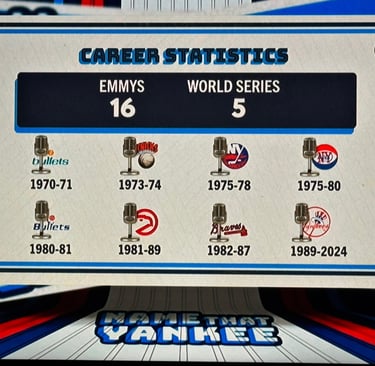
He also was an Emmy-winning executive producer of Yankee telecasts for WPIX,
where he also served as the station's VP for Public Relations, and produced
pre-season football for the New York Giants and New York Jets. Appel has also
worked for the Atlanta Committee for the Olympic Games and The Topps Company,
both in public relations capacities. He currently heads his own firm, Marty
Appel Public Relations.
Appel has
written 16 books, including his memoir Now Pitching for the Yankees, a
biography of King Kelly, and children's biographies of Yogi Berra and Joe
DiMaggio. He has collaborated with Eric Gregg, Larry King, Bowie Kuhn, Lee
MacPhail, Thurman Munson, and Tom Seaver. He has also written forewords to books
and contributed to a variety of publications, including Sports Collectors
Digest, Yankees Magazine and Encyclopedia Americana. His Kelly
biography, Slide, Kelly, Slide, won the Casey Award in 1996 as best
baseball book of the year.
He has
served a member of the Board of Directors for the
Appel is
frequently interviewed for YES Network, HBO and ESPN Classic programming. He was
a consultant for 61*, a Billy Crystal film aired on HBO, and The Bronx
is Burning, a movie airing on ESPN, in which he played himself in one scene.
He also appeared in Woody Allen's The Purple Rose of Cairo as a
restaurant patron, and as himself in a film about Barry Bonds' 73rd home run
ball, called Up For Grabs.
Appel married Patricia Alkins in 1975 and they were divorced in 1996. They have two children, Brian (Promotion Director for the Boston Phoenix) and Deborah (a music industry executive).
|
SABR
Nine: Former Yankees Public Relations Director Marty Appel |
|
For
many baseball purists, the term "public relations" can be a dirty word.
But for sports expert
Marty Appel,
the art of quality sports communications and public relations has
consumed most of his adult life.
According to his autobiography,
Now Pitching for the Yankees,
Appel was the youngest public relations director ever selected to lead a
major league baseball team and was George Steinbrenner’s first hire in
that position with the
Beyond
his own autobiography, Appel is also an established author in his own
right having authored 15 other books including collaborations with Larry
King, Bowie Kuhn, Tom Seaver, Lee MacPhail, umpire Eric Gregg and
Thurman Munson.
A SABR
member since 1977, this feature alone cannot capture the immeasurable
contributions Appel has made to the greater baseball consciousness.
Consider this edition of the SABR Nine a short look into the long career
of Marty Appel, who has spent over forty years exploring the truths that
baseball has to offer and revealing them to the public in the best
possible light.
How
did you get your start with the Yankees organization?
I
wrote to Bob Fishel in the summer of ’67 asking for any sort of a summer
job. My timing was perfect; he was besieged by cartons of unanswered
mail to Mickey Mantle and wanted to get them answered. So it was a good
letter, good timing, and I had a good background. Plus my interview went
well.
What
were some of the best and worst things about handling Mickey Mantle’s
fan mail?
Best
thing was saving up a few to go over with him personally. "Quality time"
with Mick. Worst was that eventually, it did get a bit boring. The
letters weren’t all that interesting: "Dear Mickey, You are my favorite
player, can you please send me an autographed baseball."
You
were working in the Yankees public relations department when "Ball Four"
was published. What was your initial reaction and the mood in your
office when the book became popular?
My
initial reaction was of course influenced by the shock and outrage
within the baseball community, but I came to see it as one of the most
important books on baseball ever written, and many people today tell me
it is the book that made them fall in love with baseball. The lasting
impact doesn’t surprise me - it was a breakthrough book. It still reads
well.
You
directed public relations for the
The
Olympics had little to do with sports until the final days; the years
leading up to the games are all about politics, zoning, construction,
security, doping, transportation, housing, special interest groups, and
so on. Amateur sports today so closely resembles pro sports that the day
of the pure amateur elite athlete is gone. Little difference between pro
and amateur.
Of all
the baseball icons you have collaborated with on books, which one stands
out in your mind as the most memorable experience?
It was
fun to work with Thurman Munson on his book but my most memorable
experience would have been collaborating with Commissioner Bowie Kuhn on
his memoirs. It’s a very important book about his 17-year era when much
of what we know about baseball changed. The personal profiles of the
owners and MLB officials are fascinating. We did 100 hours on tape in
compiling the book.
As a
Thurman Munson biographer, how did the Cory Lidle tragedy affect you and
did you see parallels between the two events?
Not
only did the Lidle accident bring back sad memories, but that very
morning I was watching video of 1979 newscasts about Thurman’s accident,
in preparation for a new Munson project I’m embarking on. Not only that,
the two days before, I had been on the set of a new ESPN movie, "The
Bronx is Burning," with actor Erik Jensen, who plays Thurman and looks
just like him.
The
parallel I saw is that athletes, being athletes, generally are risk
takers and see themselves as indestructible.
In
your experience, how integral a component is public relations to the
appeal of the professional baseball game?
There
was a time when PR set the agenda for news coverage; what we gave to the
media was the day’s news. Now, the media sets the pace and PR tries to
keep up. But there are so many great things about baseball, that it’s
sometimes necessary to remind people of them, and that’s where
the PR role is so important. Craig Biggio is going to be a 3,000 hit guy
next year, imagine that. PR is needed to let everyone outside of
What
things have inspired you and how do you measure success as a sports
public relations professional?
I was
sitting in the upper deck above home plate for Game Six of the 1986
World Series. The Mets didn’t have a prayer but the fan on my left,
there all by himself and obviously devoted to the Mets, wouldn’t quit.
"We can do it, we can do it," he kept repeating out loud, almost in
tears. And hey, they did it. We’ve seen the replays 1000 times. And it
brought him such joy, that I never forget him when I think about
delivering this form of entertainment to the masses.
What
advice do you have for anyone trying to break in to sports communication
today?
Bring
the skills of a journalist with you. Talk the same language, understand
their world.
|