Brad's
Ultimate New York Yankees Website -
www.HistoryOfTheYankees.com
Yankee Stadium Information

Click here for the Yankee Stadium Photo Gallery
Yankee Stadium
Bronx, New York 10451
1-718-579-4495
www.Yankees.com
To order Yankees Magazine call 1-800-GO-YANKS
FAN MAIL
The Yankees offer a free fan package, containing team schedules, information,
pictures and stickers, to all their loyal fans. Fans interested in receiving a
package should send a postcard to:
Yankee
Ticket Office
1-718-293-6013
For Group Sales Call 1-718-293-6000Stadium
is located at 161st Street and River Avenue in the Bronx.
Northbound exit - I-87 Exit 4 or Exit 5
Southbound exit - I-87 Exit 6
-There
are 15 Yankee Parking lots that surround the stadium that in run by the Kinney
Company.
-A Subway is located at the corner of 161st. and River Avenue
-Buses are available to and from the Stadium. Call NYC Transit Authority at
1-718-330-1234 for more information
-A Ferry is also available to and from the stadium. Call 1-800-53- FERRY for
more information.
|
Dimensions
Left Center - 399 Center - 408 Right Center - 385 Right Field - 314 |
Yankee Stadium Information
MONUMENT PARK:
Contains historic monuments and plaques to former Yankee greats such as Babe
Ruth, Lou Gehrig, Mickey Mantle and Joe DiMaggio. Park is open from the time the
gates open until 45 minutes prior to the game. Access the park via staircase at
the end of the aisles between Field and Main Level Section 36. The park is
closed between doubleheaders and during inclement weather.
GATE
OPENING TIMES
All gates open 1 1/2 hours prior to game time Monday through Friday for night
games. All gates open 2 hours prior to game time on Saturday and Sunday.
PEDESTRIAN MALL:
Formerly East 157th St., the Sidewalk Cafe, Advance Ticket Sales, Day of Game
and Reservation windows can be found in the Mall area.
CUSTOMER SERVICE BOOTHS:
The Guest Services area is located on the Loge Level, Section 3. It is staffed
with knowledgeable guest service representatives who will be able to assist you
with questions and concerns. Additional information booths: Sections 2, 9 and
33, Field Level; Section 3, Main Level; Section 7, Loge Level; Section 4, Tier
Level
AUTOMATIC TELLER MACHINES:
Section 9 and Section 20, Field Level
FIRST AID / MEDICAL:
First Aid Stations are located on the Field Level, Section 2, Main Level,
Section 15 and Main Level, Section 28. If medical assistance is needed, please
notify the nearest Security Guard or go to the nearest First Aid Station.
ADVANCE TICKET WINDOW:
Section 9, Field Level
ELEVATORS / ESCALATORS
The Yankees provide a permanently stationed elevator operator in each Stadium
elevator used by the general public. Wheelchair disabled guests may take the
elevators at Field Level, Section 13, Main Level, Section 13 or Loge Level
Section 12 to access all levels of Yankee Stadium. The elevator at Field Level,
Section 13 does not provide access to the Club Level Suites, you must take the
elevator located in the Yankees lobby at Field Level, Section 2.
There are also three escalator locations at Yankee Stadium. Refer to the map for locations.
EMERGENCY EVACUATIONS
Yankee Stadium personnel have been trained in evacuation procedures. Should an
emergency evacuation situation occur, emergency information would be displayed
on the scoreboard and announced on the public address system.
TDD
PHONES
TDD phones are located on the Field Levels. Ask any Guest Relations host for
additional information.
WHEELCHAIR ACCESSIBLE PARKING
Wheelchair accessible parking is available at all 11 Kinney Parking Lots
surrounding Yankee Stadium. The Yankees have designated 75 parking spaces, 96
inches wide and include access aisles for this purpose. Twenty of the 75 spaces
are also accessible to high top fans. Only vehicles with state-issued disabled
parking plates or permits are permitted in these areas.
BOTTLES AND CANS:
A New York City ordinance prohibits fans from bringing cans, bottles (glass or
plastic), jugs, coolers or hard containers of any kind into the Stadium. This is
a safety measure to protect fans as well as team and Stadium personnel. If these
items are found to be in your possession prior to entering the Stadium,
personnel will ask you to dispose of the item(s). Once you enter the Stadium,
canned or bottled goods will be confiscated and disposed of and coolers, jugs,
etc. will be checked at the gate to be picked up as you leave the Stadium.
BANNERS AND SIGNS:
The following rules apply to the display of these items:
They may not be hung in fair territory or any part of the playing field or as to obstruct the view of fans or Stadium signage.
They may only be held up in, or paraded through, the general seating area between innings.
The use of weights of any kind to keep a banner or sign in place is strictly prohibited.
Note: If any banner or sign interferes with the sight line of the players, the umpires may request its removal.
MAIN
GIFT SHOPS:
Sections 24 and 25, Field Level
NON
ALCOHOL SECTIONS:
Sections 13 and 14, Tier Reserved
NO
SMOKING:
There is no smoking anywhere within the confines of Yankee Stadium.
DESIGNATED DRIVER BOOTH:
In return for promising responsibility for the safe and sober transportation of
their group from the Stadium, a registrant will receive coupons for free sodas
during the game at which they enroll. Designated drivers must be 21 years of age
and have a valid driver's license. Section 4, Field Level
HALL
OF FAME SUITES:
Sections 9, 10, 13, 15, 16, 19, 20, 21, 25, 31, 32, 33 and 34, Loge Level
LUXURY SUITES:
Club Level
GREAT MOMENTS ROOM:
Club Level
STADIUM CLUB:
Section 12, Field Level
YANKEE CLUB:
Club Level
PINSTRIPE PUB:
Section 8, Field Level
A little history of the Stadium....
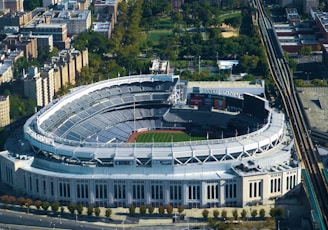
Asked to leave the Polo Grounds when his Yankees began outdrawing the Giants in 1920, owner Jacob Ruppert seized the opportunity to build what would become the most famous stadium in all of baseball, a triple-decked wonder called Yankee Stadium.
Erected on the site of a Bronx lumberyard just across the Harlem River from the Polo Grounds, Yankee Stadium was quickly dubbed "The House That Ruth Built" to honor the Yankee whose home runs were revolutionizing the game (and filling Ruppert's coffers). On April 18, 1923 Ruth's three-run home run led the Yankees to a 4-1 win over the Red Sox in the stadium's first game.
The grandstand was extended around the foul poles by 1928, with wooden bleachers surrounding the rest of the outfield, and the top of the stadium was ringed with a distinctive white fence facade.
Like the stadium, the playing field itself was quite remarkable. The left- and right-field corners were only 281' and 295' in 1923, but left sloped out dramatically to 460' while center was a near-impossible 490' away.
Deep left and center fields became known as Death Valley as many a right-handed slugger watched towering fly balls die there. Eventually, stone monuments to Ruth, Lou Gehrig, and Miller Huggins were erected in deep left center, and although considered to be in the field of play they were rarely reached by batted balls.
Lights were added in 1946, and the stadium remained virtually unchanged until 1973, when it was closed completely for two years of renovations and modernization.
The stadium was reopened in 1976 with major structural improvements.
Bulky support poles for the upper decks had been eliminated, along with the corresponding obstructed-view seats, and escalators improved access to the upper decks.
Naturally, Yankee Stadium has been the scene of many of baseball's greatest moments.
More History !!
|
One word can describe Yankee Stadium, historical. Since its opening, Yankee Stadium has been home to more Hall of Famer’s, and more than two dozen World Championship teams, than any other stadium ever built. The New York Yankees then known as the New York Highlanders (1903-1912), began playing at 16,000 seat Hilltop Park in 1903. The team played at Hilltop Park until after the 1912 season, when the lease expired. The team |
|
then accepted an invitation to play at Polo Grounds, where the New York Giants played. With the move to Polo Grounds, the Highlanders changed their name to the Yankees. However, the team only spent ten years at the Polo Grounds. With the Yankees’ Babe Ruth setting homerun records, and the Yankees drawing more fans than the Giants, the Giants served an eviction notice to the Yankees in 1921, that began after the 1922 season. Immediately the Yankees’ owners began looking for land to build a new ballpark on. A 10 acre site, less than a mile from Polo Grounds in the Bronx was bought to build the stadium on. Designed by Osborn Engineering Company, originally, the plan was for a triple-decked stadium, with grandstands circling the field. But because the stadium seemed too foreboding, the original plans were scaled back. Instead, the ballpark became the first to have three tiers of seating consisting of 58,000 seats. Because of the size, the new ballpark became the first to be called a stadium. Construction of the stadium began on May 5, 1922. The stadium was built of mainly steel and concrete. The triple decked grandstand extended behind home plate and up the base lines. The lower deck continued until it met the wooden bleachers behind the outfield fence. A 15-foot copper facade was erected to adorn the stadium's third deck, which became one of the stadium's most recognized and grandest features. The scoreboard was located beyond the bleachers, in right field. Completed in only 284 days, opening day came on April 18, 1923. The ballpark was given the name Yankee Stadium. Original dimensions at Yankee Stadium were 295 ft. (right), 490 ft. (center), and 281 ft. (left). Centerfield became known as "Death Valley" because of its distance from home plate. It was only several years before any changes took place at Yankee Stadium. The triple decked grandstand was extended into left field in 1928, and the same extension was done in right field in 1937. Concrete bleachers replaced the wooden bleachers beyond the outfield fence. With the addition of the grandstands, the capacity of Yankee Stadium, grew to 80,000, but soon dropped to the 70,000’s. The first of many monuments and plaques was added in 1932, which became known as "Monument Park" in fair territory in dead center field, when a monument to former manager Miller Huggins was erected. Monuments of Babe Ruth, Lou Gehrig, and others were erected in years following 1932. Night baseball came to Yankee Stadium on May 28, 1946. A new scoreboard was installed in 1959. Other sports, such as boxing and football were played at Yankee Stadium until the early 1970's. In the early 1970’s Yankee Stadium began showing its age. In 1971, Yankees owner Mike Burke, began talking about building a new stadium in New Jersey. But the mayor of New York City, John Lindsay announced that the city would buy and renovate Yankee Stadium. The city bought the stadium for $24 million in 1972. In the same year, George Steinbrenner bought the team. The Yankees played in Yankee Stadium for one more year, before drastic changes were made. Renovations began immediately after the 1973 season. While Yankee Stadium was renovated, the Yankees played at Shea Stadium, home of the New York Mets. Parts of Yankee Stadium were completely demolished. Changes were made to eliminate posts and columns, which supported the upper deck. The copper facade atop the upper deck was removed, and replicated at the top of a new scoreboard, which runs from center field to right field. New 22 inch blue plastic seats replaced old 18 inch wooden green seats, thus reducing the capacity to 54,000. New luxury suites and concessions were added, along with the remodeling of the press box and restrooms. To eliminate climbs to the third level, escalators and elevators were added to parts of the exterior of the stadium. The exterior of Yankee Stadium was repainted, and a 138 foot tall replica of a Louisville Slugger baseball bat was placed near the entrance of the stadium. After two years of renovations Yankee Stadium was finally ready to reopen. Yankee Stadium reopened on April 15, 1976. The stadium went from being known as "The House that Ruth Built" to "The House Steinbrenner Rebuilt". The thing which most people noticed, was that the monuments in centerfield were no longer there. They had been moved to "Monument Park" behind the centerfield wall. Since the late 1970's very few changes have taken place at Yankee Stadium. The stadium still remains the home to many great ballplayers, and an excellent place to see a game. Since its opening in 1923, Yankee Stadium has been home to 26 World Championship teams. In December of 2001, the Yankees and the City of New York tentatively agreed to build a new retractable roof stadium, adjacent to Yankee Stadium. If built the stadium would open in 2007. |
Yankee Stadium Attendance Records
REMODELED
STADIUM, REGULAR SEASON
ALL-TIME
STADIUM RECORDS
TOP 20 CROWDS
AT NEW YANKEE STADIUM
TOP 20
REGULAR-SEASON CROWDS AT NEW YANKEE STADIUM
|
1901-1902 |
||||||||||||||||||||||||||||||||||||||||||||||||||||||||||||||||||||||||||||||||||||||||||||||||||||||||||||||||||||||||||||||||||||||||||||||||||||||||||||||||||||||||||||||||||||||||||||||||||||||||||||||||||
|
Year |
Ballpark |
Attendance |
||||||||||||||||||||||||||||||||||||||||||||||||||||||||||||||||||||||||||||||||||||||||||||||||||||||||||||||||||||||||||||||||||||||||||||||||||||||||||||||||||||||||||||||||||||||||||||||||||||||||||||||||
|
Game Avg. |
Season Total |
League Avg. |
||||||||||||||||||||||||||||||||||||||||||||||||||||||||||||||||||||||||||||||||||||||||||||||||||||||||||||||||||||||||||||||||||||||||||||||||||||||||||||||||||||||||||||||||||||||||||||||||||||||||||||||||
|
|
|
|
|
||||||||||||||||||||||||||||||||||||||||||||||||||||||||||||||||||||||||||||||||||||||||||||||||||||||||||||||||||||||||||||||||||||||||||||||||||||||||||||||||||||||||||||||||||||||||||||||||||||||||||||||
|
1903-1912 |
||||||||||||||||||||||||||||||||||||||||||||||||||||||||||||||||||||||||||||||||||||||||||||||||||||||||||||||||||||||||||||||||||||||||||||||||||||||||||||||||||||||||||||||||||||||||||||||||||||||||||||||||||
|
Year |
Ballpark |
Attendance |
||||||||||||||||||||||||||||||||||||||||||||||||||||||||||||||||||||||||||||||||||||||||||||||||||||||||||||||||||||||||||||||||||||||||||||||||||||||||||||||||||||||||||||||||||||||||||||||||||||||||||||||||
|
Game Avg. |
Season Total |
League Avg. |
||||||||||||||||||||||||||||||||||||||||||||||||||||||||||||||||||||||||||||||||||||||||||||||||||||||||||||||||||||||||||||||||||||||||||||||||||||||||||||||||||||||||||||||||||||||||||||||||||||||||||||||||
|
|
|
|
|
||||||||||||||||||||||||||||||||||||||||||||||||||||||||||||||||||||||||||||||||||||||||||||||||||||||||||||||||||||||||||||||||||||||||||||||||||||||||||||||||||||||||||||||||||||||||||||||||||||||||||||||
|
1913-2003 |
||||||||||||||||||||||||||||||||||||||||||||||||||||||||||||||||||||||||||||||||||||||||||||||||||||||||||||||||||||||||||||||||||||||||||||||||||||||||||||||||||||||||||||||||||||||||||||||||||||||||||||||||||
|
Year |
Ballpark |
Attendance |
||||||||||||||||||||||||||||||||||||||||||||||||||||||||||||||||||||||||||||||||||||||||||||||||||||||||||||||||||||||||||||||||||||||||||||||||||||||||||||||||||||||||||||||||||||||||||||||||||||||||||||||||
|
Game Avg. |
Season Total |
League Avg. |
||||||||||||||||||||||||||||||||||||||||||||||||||||||||||||||||||||||||||||||||||||||||||||||||||||||||||||||||||||||||||||||||||||||||||||||||||||||||||||||||||||||||||||||||||||||||||||||||||||||||||||||||
|
|
| ||||||||||||||||||||||||||||||||||||||||||||||||||||||||||||||||||||||||||||||||||||||||||||||||||||||||||||||||||||||||||||||||||||||||||||||||||||||||||||||||||||||||||||||||||||||||||||||||||||||||||||||||